

How to Start Sketchbooking for Beginners This Autumn (Even If You Haven't Drawn in Years)
Sketchbooking for beginners in autumn starts with one simple decision: pick up whatever pencil or pen is closest to hand, open a blank page, and make a mark on it. You don't need a fancy sketchbook, a full set of materials, or any idea what you're going to draw. You just need to start.

Autumn is honestly one of the best times of year to begin. The evenings draw in, routines settle back into place after summer, and there's something about that cosy, back-to-normal energy that makes sitting down with a sketchbook feel less like a chore and more like coming home.
I get this question a lot, especially from people who haven't drawn since school, or who have a stash of art materials sitting in a drawer they've never properly used. Here's how I'd suggest you begin.
Start smaller than you think you need to
The biggest thing that stops people starting a sketchbook practice isn't lack of talent. It's overthinking the setup. Waiting for the "right" sketchbook, the "right" materials, the "right" amount of time.
You don't need any of that. A cheap sketchbook and a pencil is a complete sketchbooking kit. If you've got coloured pencils, watercolours, or markers sitting unused somewhere in your house, even better, this is your excuse to finally open them.
I still remember starting again as an adult with my late grandmother's old watercolour set sitting on my kitchen table. Half the pans were cracked and nothing matched what any tutorial told me to buy. It worked anyway. That's usually the truth about materials: what you already own is enough to begin.
Give yourself five minutes, not an hour
Don't plan for a big session. Give yourself five or ten minutes and one small, ordinary thing to draw: your cup of tea, your own hand, the view out of your window. Small subjects lower the pressure and get you past the blank page faster than anything else.
Do this a few times a week rather than once for hours. Sketchbooking is a habit you build with small, repeated visits, not one big heroic effort.


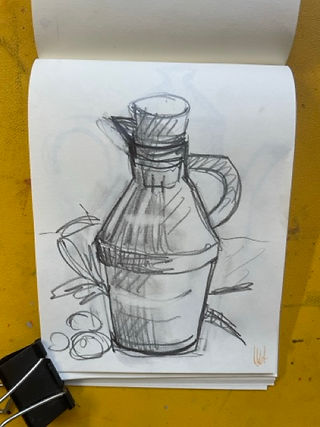


Let the page be messy
Your first pages will look wobbly. Mine still do, some days. That's not a sign you're doing it wrong, it's what sketchbooking actually looks like. A sketchbook isn't a finished portfolio. It's a place to test things, get things wrong, and see what happens when you try a colour or a mark you've never used before.
Permission to be imperfect is the whole point. The sketchbook page that looks "bad" to you is still doing its job: building your hand, your eye, and your confidence, one small drawing at a time.
Autumn gives you built-in inspiration
If you're not sure what to draw, let the season do the work. Conkers, changing leaves, a mug of something warm, the first jumper of the year, your window fogging up in the morning. Autumn hands you a whole list of small, cosy subjects without you having to think too hard.
I've taught thousands of students since 2019, and every autumn I notice the same thing: this is the season people come back to their sketchbooks, even after a long break. There's something about it that makes starting again feel natural instead of forced.
If you want some company while you do it, I'm running a two week Autumn Creative Reset inside Sketchbook Circle from October 12st to the 25th, built entirely around dusting off the materials you already own and getting back into your sketchbook without any pressure to be good at it. It's not required to start sketchbooking this autumn, just there if you'd like some structure and company along the way.
Sketchbooking for Beginners: FAQ
Do I need to buy new art materials to start sketchbooking?
No. A pencil and any notebook or sketchbook you already own is enough to begin. Add materials later once you know what you enjoy using.
How often should I sketch as a beginner?
A few short sessions a week works better than one long one. Five to ten minutes, a handful of times a week, builds the habit faster than an occasional hour-long session.
What should I draw if I don't know where to start?
Draw whatever is in front of you. Your cup of tea, your hand, the view from your window. Small, everyday objects are the easiest way past a blank page.
Is it too late to start sketchbooking if I haven't drawn in years?
Not at all. Many of my students haven't picked up a pencil in decades before they start again. The materials don't expire, and neither does your ability to learn.
Why is autumn a good time to start a sketchbook practice?
The season naturally gives you cosy routines and easy subjects to draw, and the slower pace after summer makes it easier to fit in small, regular sketching sessions.


